Royal Chariot Equipment and Ceremonial Horse Trappings
0:00 / 1:30
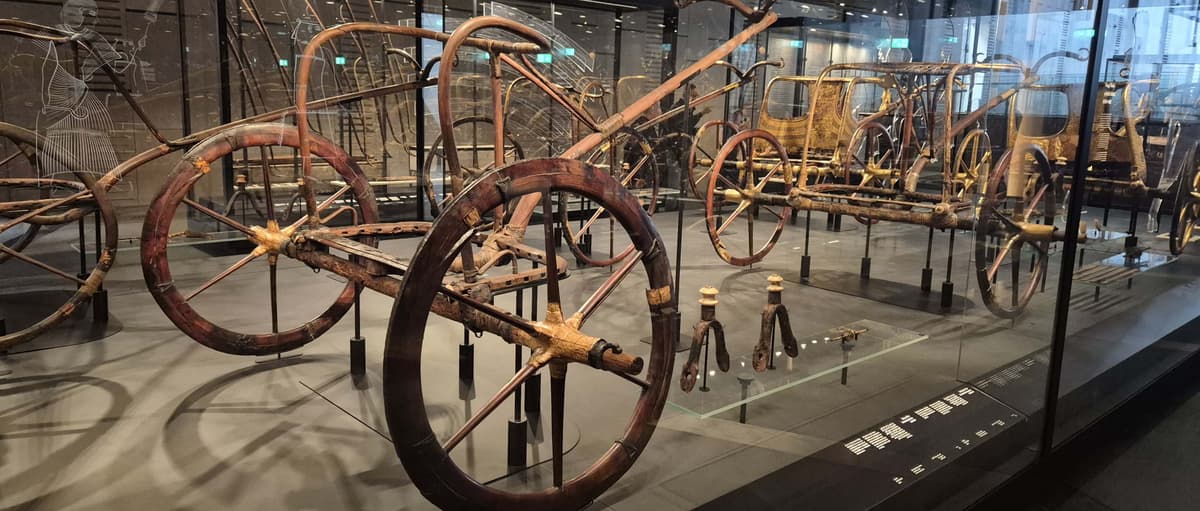
This collection of objects belonged to the royal chariots and horses of Tutankhamun, one of the most famous rulers of ancient Egypt’s New Kingdom. Discovered in 1922 by the archaeologist Howard Carter in the tomb of the young king in the Valley of the Kings, these artifacts provide a fascinating glimpse into the royal lifestyle, military traditions, and ceremonial practices of ancient Egypt.
During the New Kingdom period, chariots were among the most important symbols of royal power. Introduced into Egypt around the Second Intermediate Period, the horse-drawn chariot quickly became a central element of warfare, hunting, and royal display. By the time of Tutankhamun, chariots represented both military technology and the prestige of the pharaoh.
The objects displayed here include horse trappings, decorative harness components, ceremonial whisks, a whip, and elements connected to the king’s chariots. Together they illustrate the sophisticated equipment used to control and decorate the royal horses that pulled the king’s chariots.
Among the most striking pieces are the horse trappings, which include yoke saddles that rested across the shoulders of the horses. These structures allowed the reins and harnesses to be secured properly so the animals could pull the chariot efficiently. Some pieces include protective blinkers shaped like the wedjat eye, a sacred symbol in Egyptian culture representing protection, healing, and divine watchfulness.
Other decorative elements were designed not only for function but also for symbolism. Some parts of the harness are adorned with the heads of Bes, a god associated with protection, particularly against evil spirits and harmful forces. Placing the image of Bes on horse equipment was believed to guard both the king and the animals during travel, hunting, or battle.
Also included in this display are ceremonial fly whisks and a whip. Fly whisks were important symbols of authority in ancient Egypt and were often associated with kingship. These particular examples are made from bundles of reeds and horsehair tied together with leather. Their handles are carved with lion heads, which symbolize strength and royal power. The whip handle, crafted from ivory, bears the names and titles of the king, reinforcing its association with royal authority.
Another remarkable object is the decorative falcon with a solar disk, which was originally attached to one of the king’s chariots. The falcon was a powerful symbol in ancient Egyptian religion and was closely connected to the sky god Horus, the divine protector of the pharaoh. When mounted on the chariot, the falcon faced forward, symbolically leading the king toward victory in battle and demonstrating his divine legitimacy as ruler of Egypt.
The presence of these objects in Tutankhamun’s tomb reflects the belief that the king would continue to use such equipment in the afterlife. According to ancient Egyptian religious beliefs, death was not the end of existence but a transformation into a new eternal life. The objects buried with the king were intended to ensure that he would possess everything he needed in the next world.
In addition to their religious significance, these artifacts demonstrate the remarkable craftsmanship of the artisans who worked for the royal court. Materials such as gold, bronze, wood, leather, ivory, glass, and semi-precious stones were carefully combined to produce objects that were both functional and visually impressive.
Together, these chariot and horse-related objects illustrate an important aspect of ancient Egyptian royal culture. They reveal how the king’s power was expressed not only through monumental temples and tombs but also through the elaborate equipment used in daily life, ceremonies, and warfare.
Today, these artifacts allow modern visitors to imagine the young king riding in his chariot, leading hunts across the desert, participating in ceremonial processions, and demonstrating the strength and prestige of the Egyptian monarchy more than three thousand years ago.This collection of objects belonged to the royal chariots and horses of Tutankhamun, one of the most famous rulers of ancient Egypt’s New Kingdom. Discovered in 1922 by the archaeologist Howard Carter in the tomb of the young king in the Valley of the Kings, these artifacts provide a fascinating glimpse into the royal lifestyle, military traditions, and ceremonial practices of ancient Egypt.
During the New Kingdom period, chariots were among the most important symbols of royal power. Introduced into Egypt around the Second Intermediate Period, the horse-drawn chariot quickly became a central element of warfare, hunting, and royal display. By the time of Tutankhamun, chariots represented both military technology and the prestige of the pharaoh.
The objects displayed here include horse trappings, decorative harness components, ceremonial whisks, a whip, and elements connected to the king’s chariots. Together they illustrate the sophisticated equipment used to control and decorate the royal horses that pulled the king’s chariots.
Among the most striking pieces are the horse trappings, which include yoke saddles that rested across the shoulders of the horses. These structures allowed the reins and harnesses to be secured properly so the animals could pull the chariot efficiently. Some pieces include protective blinkers shaped like the wedjat eye, a sacred symbol in Egyptian culture representing protection, healing, and divine watchfulness.
Other decorative elements were designed not only for function but also for symbolism. Some parts of the harness are adorned with the heads of Bes, a god asso ... Découvrez plus avec Premium !
Débloquez toute l'histoire de cet artéfactPassez à Premium pour accéder à la description complète, aux guides audio et au contenu exclusif de tous les artéfacts.Accédez aux guides audio complets, descriptions détaillées et assistant vocal pour les visites des principales œuvres du GEM pour seulement 3.99 $