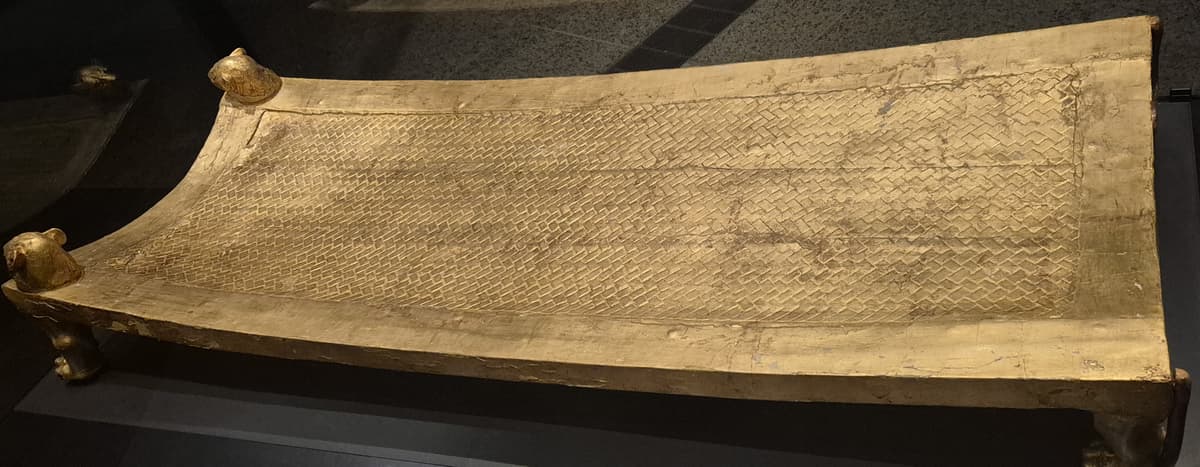
The Bier displayed here is one of the important structural elements discovered in the burial chamber of Tutankhamun, the young king who ruled Egypt during the 18th Dynasty of the New Kingdom around 1332 to 1323 BCE. This object formed part of the elaborate burial equipment that surrounded the pharaoh’s sarcophagus and coffins. It was discovered in 1922 by the archaeologist Howard Carter in the king’s tomb in the Valley of the Kings.
A bier is a platform used to support a coffin or the body of the deceased during funeral rituals and burial. In Tutankhamun’s tomb this wooden bier carried the enormous weight of the three nested coffins that protected the king’s mummy. These coffins included the famous solid gold inner coffin that enclosed the body of the pharaoh. The bier supported this structure inside the stone sarcophagus for more than three thousand years.
The bier itself is made from wood and decorated with gold elements. At its ends are carved lion heads, a detail that carried powerful symbolic meaning in ancient Egyptian religion. Lions were often associated with strength, protection, and the horizon where the sun rose and set. In Egyptian cosmology the horizon symbolized the transition between worlds, making the lion an appropriate guardian figure for the journey from life into the afterlife.
In ancient Egyptian funerary belief the burial equipment of a king was not only practical but also magical. Every object placed inside the tomb was believed to have protective and symbolic power. The presence of the lion heads on the bier suggests that it was intended to guard the body of the king and protect the sacred coffins resting upon it.
The bier also played an important role in funeral ceremonies before the burial itself. During royal funerals the mummy and coffin were carried in processions and placed on ceremonial platforms like this one while priests performed rituals and recited sacred texts. These ceremonies were intended to transform the deceased ruler into an eternal being who could live among the gods.
The survival of this bier after more than three thousand years is remarkable. It reminds us that the burial of an Egyptian pharaoh involved not only magnificent treasures but also carefully designed structures that supported and protected the king’s body.
Today this object helps us understand the complexity of royal burial practices in ancient Egypt. Even a seemingly simple platform carried both symbolic and spiritual importance in the journey of a king toward eternal life.The Bier displayed here is one of the important structural elements discovered in the burial chamber of Tutankhamun, the young king who ruled Egypt during the 18th Dynasty of the New Kingdom around 1332 to 1323 BCE. This object formed part of the elaborate burial equipment that surrounded the pharaoh’s sarcophagus and coffins. It was discovered in 1922 by the archaeologist Howard Carter in the king’s tomb in the Valley of the Kings.
A bier is a platform used to support a coffin or the body of the deceased during funeral rituals and burial. In Tutankhamun’s tomb this wooden bier carried the enormous weight of the three nested coffins that protected the king’s mummy. These coffins included the famous solid gold inner coffin that enclosed the body of the pharaoh. The bier supported this structure inside the stone sarcophagus for more than three thousand years.
The bier itself is made from wood and decorated with gold elements. At its ends are carved lion heads, a detail that carried powerful symbol ... Discover more with Premium!
Unlock the Full Story of This ArtifactUpgrade to premium to access the complete description, audio guides, and exclusive content for all artifacts.Access full audio guides, detailed descriptions, and voice tour assistant for the GEM's main artifacts for only $3.99