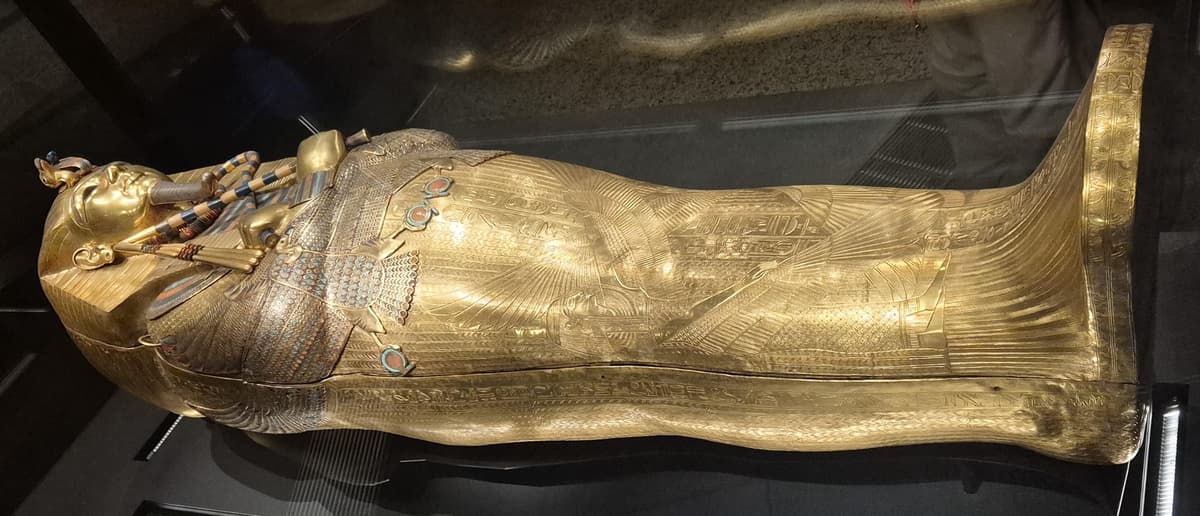
The Sarcophagus and Coffins of Tutankhamun represent one of the most extraordinary burial assemblages ever discovered in ancient Egypt. When the tomb of the young pharaoh was uncovered in 1922 by the British archaeologist Howard Carter in the Valley of the Kings, the king’s mummy was found placed inside a remarkable system of three nested coffins, all enclosed within a large stone sarcophagus.
Tutankhamun ruled Egypt during the 18th Dynasty of the New Kingdom, around 1332–1323 BCE. Although his reign lasted less than ten years and he died at about nineteen years old, the discovery of his nearly intact tomb transformed our understanding of royal Egyptian burial traditions. Unlike most royal tombs that had been looted in antiquity, Tutankhamun’s tomb preserved thousands of objects that illustrate the beliefs and craftsmanship of ancient Egypt.
At the center of this burial was the quartzite stone sarcophagus, carved from a single block of stone and decorated with protective deities carved on its corners. Inside this sarcophagus rested three anthropoid coffins, meaning they were shaped like the human body. The outer coffin, made of gilded wood, features the distinctive rishi style, decorated with feathers that symbolize the protective wings of divine birds embracing the king. This design reflects the ancient Egyptian belief that the deceased would be sheltered and reborn like the sun god.
The middle coffin, also made of gilded wood and inlaid with colored glass and semi-precious stones, continues the same feathered protective motif. Finally, the innermost coffin, which held the mummy itself, is one of the most extraordinary objects of ancient Egyptian art. It was crafted from solid gold weighing over 100 kilograms, symbolizing the eternal and divine nature of the pharaoh.
For the ancient Egyptians, gold was believed to be the flesh of the gods, a material that never tarnished and therefore represented immortality. By enclosing the king within layers of coffins, the embalmers created both physical protection and spiritual symbolism. Each layer acted as a barrier between the king and the dangers of the afterlife, while also reinforcing his transformation into a divine being.
For nearly a century after its discovery, the outer coffin remained in Tutankhamun’s tomb in the Valley of the Kings. In 2019, it was carefully transferred to the Grand Egyptian Museum for conservation and display. Today, these coffins provide visitors with a rare opportunity to witness the extraordinary skill of ancient Egyptian craftsmen and the profound religious beliefs surrounding death, protection, and eternal life.
Together, the sarcophagus and the three coffins form a powerful symbol of royal burial traditions, reminding us that the Egyptians believed death was not an end, but the beginning of a journey toward eternal existence among the gods.The Sarcophagus and Coffins of Tutankhamun represent one of the most extraordinary burial assemblages ever discovered in ancient Egypt. When the tomb of the young pharaoh was uncovered in 1922 by the British archaeologist Howard Carter in the Valley of the Kings, the king’s mummy was found placed inside a remarkable system of three nested coffins, all enclosed within a large stone sarcophagus.
Tutankhamun ruled Egypt during the 18th Dynasty of the New Kingdom, around 1332–1323 BCE. Although his reign lasted less than ten years and he died at about nineteen years old, the discovery of his nearly intact tomb transformed our understanding of royal Egyptian burial traditions. Unlike most royal tombs that had been looted in antiquity, Tutankhamun’s tomb preserved thousands of objects that illustrate the beliefs and craftsmanship of ancient Egypt.
At the center of this burial was the quartzite stone sarcophagus, carved from a single block of stone and decorated with protective deities carved on its corners. Inside this sarcophagus rested three anthropoid coffins, meaning they were shaped like the human body. The outer coffin, made of g ... Discover more with Premium!
Unlock the Full Story of This ArtifactUpgrade to premium to access the complete description, audio guides, and exclusive content for all artifacts.Access full audio guides, detailed descriptions, and voice tour assistant for the GEM's main artifacts for only $3.99