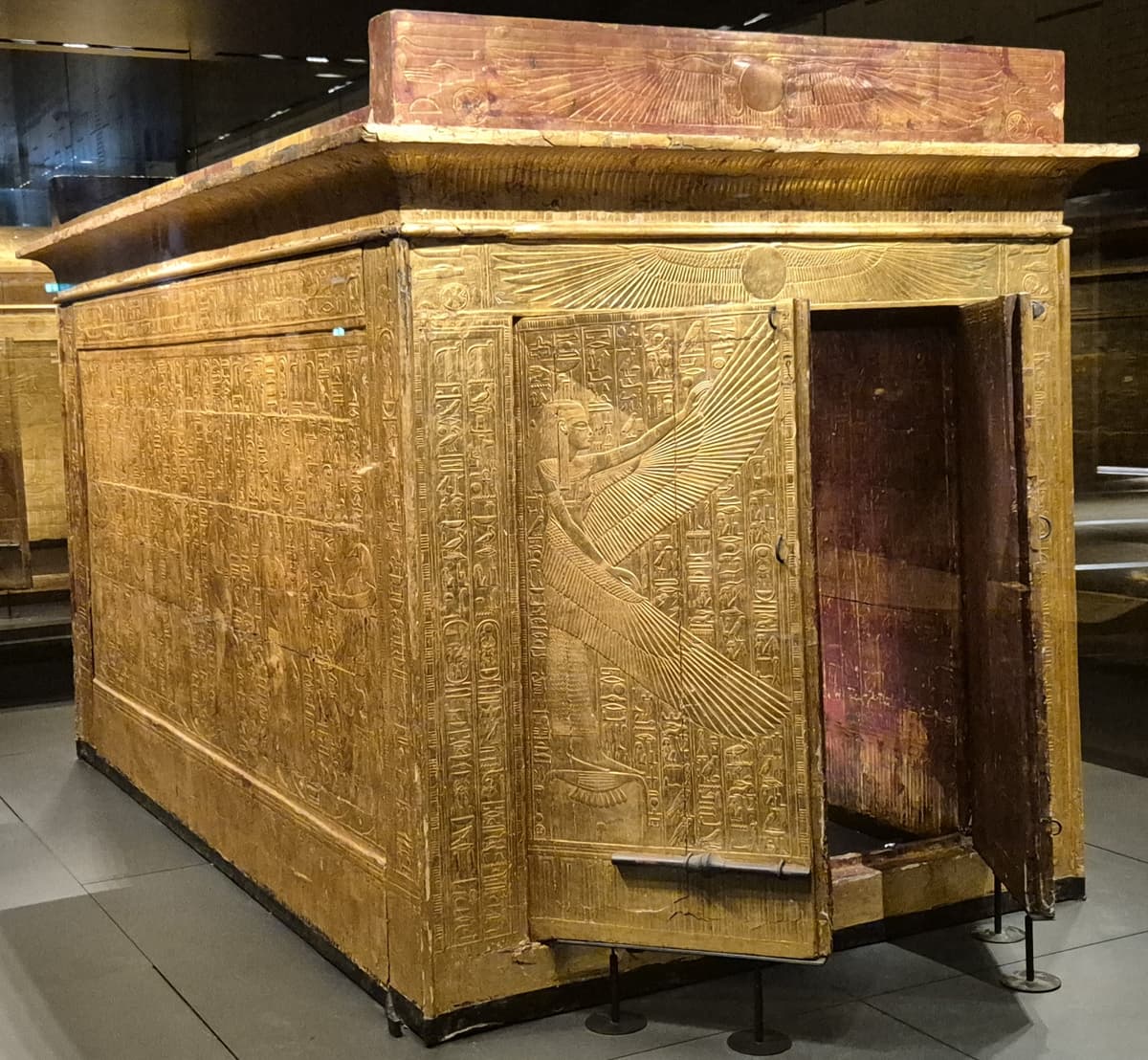
The gilded shrines of King Tutankhamun formed one of the most impressive structures ever discovered inside an ancient Egyptian tomb. Four large wooden shrines covered with gold once surrounded the king’s stone sarcophagus, each placed carefully inside the other like a series of sacred protective chambers.
These shrines stood in the burial chamber of the tomb and were so large that they almost completely filled the room. When archaeologist Howard Carter first opened the burial chamber in 1922, he did not immediately see the sarcophagus or the famous golden coffin. Instead, he encountered a massive golden shrine occupying nearly the entire space. Only after carefully dismantling each shrine layer was the sarcophagus finally revealed at the center.
The design of the shrines reflects the architecture of ancient Egyptian temples and royal palaces. Their form resembles sacred buildings associated with kingship and divine protection. By surrounding the king’s burial with these structures, the tomb symbolically recreated a temple environment where the king could undergo his transformation into an eternal divine being.
The surfaces of the shrines are decorated with elaborate religious texts and scenes that describe the journey of the king in the afterlife. Many of these inscriptions come from important funerary compositions such as the Book of the Dead and other sacred writings connected to the nightly journey of the sun through the underworld.
These texts were intended to guide and protect the king as he passed through the dangers of the afterlife. They also describe the cosmic cycle of death and rebirth that was central to ancient Egyptian religion.
According to Egyptian belief, after death the king was transformed into Osiris, ruler of the underworld and symbol of resurrection. At the same time, he was associated with the daily rebirth of the sun god Ra. The combination of these beliefs ensured that the king would be eternally reborn, just as the sun rises again each morning.
The shrines therefore functioned as more than protective structures. They formed a sacred symbolic space that recreated the universe itself, ensuring that the king’s body and spirit were protected and renewed for eternity.
Constructed from wood and covered with gold and decorative elements such as faience and glass, the shrines demonstrate the extraordinary craftsmanship of the artisans of Egypt’s New Kingdom. Their scale, beauty, and religious symbolism make them among the most remarkable objects discovered in any royal tomb.The gilded shrines of King Tutankhamun formed one of the most impressive structures ever discovered inside an ancient Egyptian tomb. Four large wooden shrines covered with gold once surrounded the king’s stone sarcophagus, each placed carefully inside the other like a series of sacred protective chambers.
These shrines stood in the burial chamber of the tomb and were so large that they almost completely filled the room. When archaeologist Howard Carter first opened the burial chamber in 1922, he did not immediately see the sarcophagus or the famous golden coffin. Instead, he encountered a massive golden shrine occupying nearly the entire space. Only after carefully dismantling each shrine layer was the sarcophagus finally revealed at the center.
The design of the shrines reflects the architecture of ancient Egyptian temples and royal palaces. Their form resembles sacred buildings associated with kingship and divine protection. By surrounding the king’s burial with these structures, the tomb symbolica ... Discover more with Premium!
Unlock the Full Story of This ArtifactUpgrade to premium to access the complete description, audio guides, and exclusive content for all artifacts.Access full audio guides, detailed descriptions, and voice tour assistant for the GEM's main artifacts for only $3.99