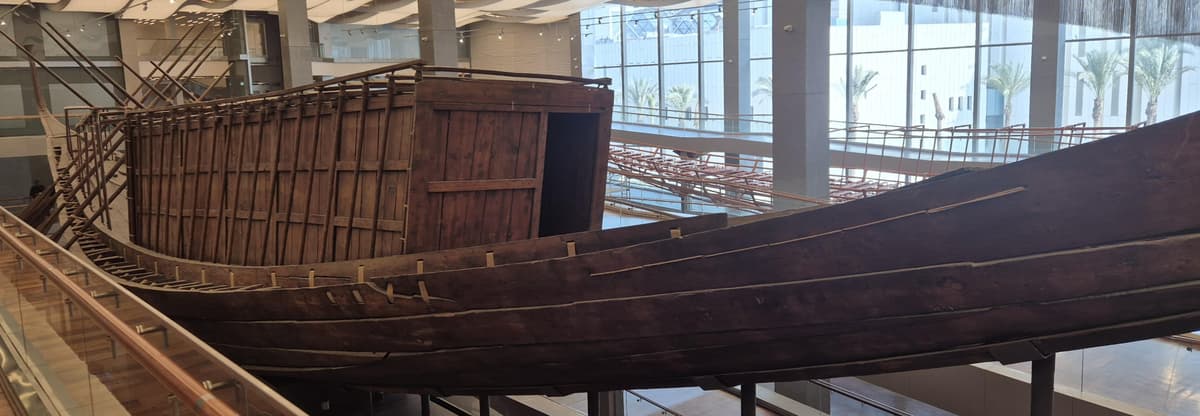
The Khufu Boats Museum presents one of the most extraordinary archaeological discoveries from ancient Egypt, connected to Khufu, the builder of the Great Pyramid at Giza Pyramid Complex. Dating back to around 2575 to 2545 BC, these remarkable vessels are known as solar boats or royal barges, and they were buried beside the pyramid as part of the king’s funerary complex.
The museum introduces visitors to two large wooden boats that were carefully dismantled in antiquity and placed in specially prepared pits. Each boat was hidden beneath massive limestone blocks, protecting it for more than four thousand years. The intention behind this burial was deeply symbolic. In ancient Egyptian belief, the pharaoh would travel with the sun god Ra across the sky and through the underworld. These boats were therefore not simple vessels but sacred objects meant to carry the king in the afterlife.
The first boat, often referred to as the Khufu solar boat, was discovered in 1954 and later carefully reconstructed. It measures more than 43 meters in length and is made primarily of cedar wood imported from Lebanon, demonstrating Egypt’s far-reaching trade networks during the Old Kingdom. The construction technique is especially fascinating. The boat was built without nails, using a system of wooden planks stitched together with ropes. This method reflects advanced shipbuilding knowledge and a deep understanding of materials.
The second boat remained sealed in its pit for decades, allowing archaeologists to apply more advanced scientific techniques during its excavation and conservation. Beginning in 1992 and continuing with major efforts after 2008, Egyptian and Japanese teams collaborated to study, document, and preserve the fragile wooden components. Thousands of individual pieces were carefully removed, recorded, and analyzed using modern technologies such as 3D scanning. This work provided valuable insights into how the boat was originally assembled and how it could be reconstructed with accuracy.
The process of conservation and reassembly is a story of patience and innovation. Each wooden piece had to be stabilized and treated before being placed in its correct position. Researchers studied wear patterns, tool marks, and construction methods to understand how ancient craftsmen built the vessel. This scientific approach allowed experts to recreate the structure while preserving its authenticity.
In recent years, the boats have been moved to the Grand Egyptian Museum to ensure their long-term preservation and to provide visitors with a more immersive experience. The transportation itself was a major engineering achievement, requiring careful planning and advanced equipment to protect the fragile structure. The museum now offers visitors the opportunity to explore not only the boats themselves but also the entire journey of discovery, excavation, conservation, and display.
The Khufu boats are among the oldest and largest surviving wooden structures from antiquity. They reveal important aspects of ancient Egyptian religion, technology, and royal ideology. More than just artifacts, they are powerful symbols of the journey to the afterlife and the enduring legacy of one of Egypt’s greatest kings.The Khufu Boats Museum presents one of the most extraordinary archaeological discoveries from ancient Egypt, connected to Khufu, the builder of the Great Pyramid at Giza Pyramid Complex. Dating back to around 2575 to 2545 BC, these remarkable vessels are known as solar boats or royal barges, and they were buried beside the pyramid as part of the king’s funerary complex.
The museum introduces visitors to two large wooden boats that were carefully dismantled in antiquity and placed in specially prepared pits. Each boat was hidden beneath massive limestone blocks, protecting it for more than four thousand years. The intention behind this burial was deeply symbolic. In ancient Egyptian belief, the pharaoh would travel with the sun god Ra across the sky and through the underworld. These boats were therefore not simple vessels but sacred objects meant to carry the king in the afterlife.
The first boat, often referred to as the Khufu solar boat, was discovered in 1954 and later carefully reconstructed. It measures more than 43 meters in length and is made primarily of cedar wood imported from Lebanon, demonstrating Egypt’s far-reaching trade networks during the Old Kingdom. The construction technique is especially fascinating. The boat was built without nails, using a system of w ... Entdecken Sie mehr mit Premium!
Entsperren Sie die vollständige Geschichte dieses ArtefaktsWerden Sie Premium-Mitglied, um auf die vollständige Beschreibung, Audioguides und exklusive Inhalte aller Artefakte zuzugreifen.Erhalten Sie vollen Zugriff auf Audioguides, detaillierte Beschreibungen und Sprachassistenten für Touren der wichtigsten Artefakte des GEM für nur 3.99 $